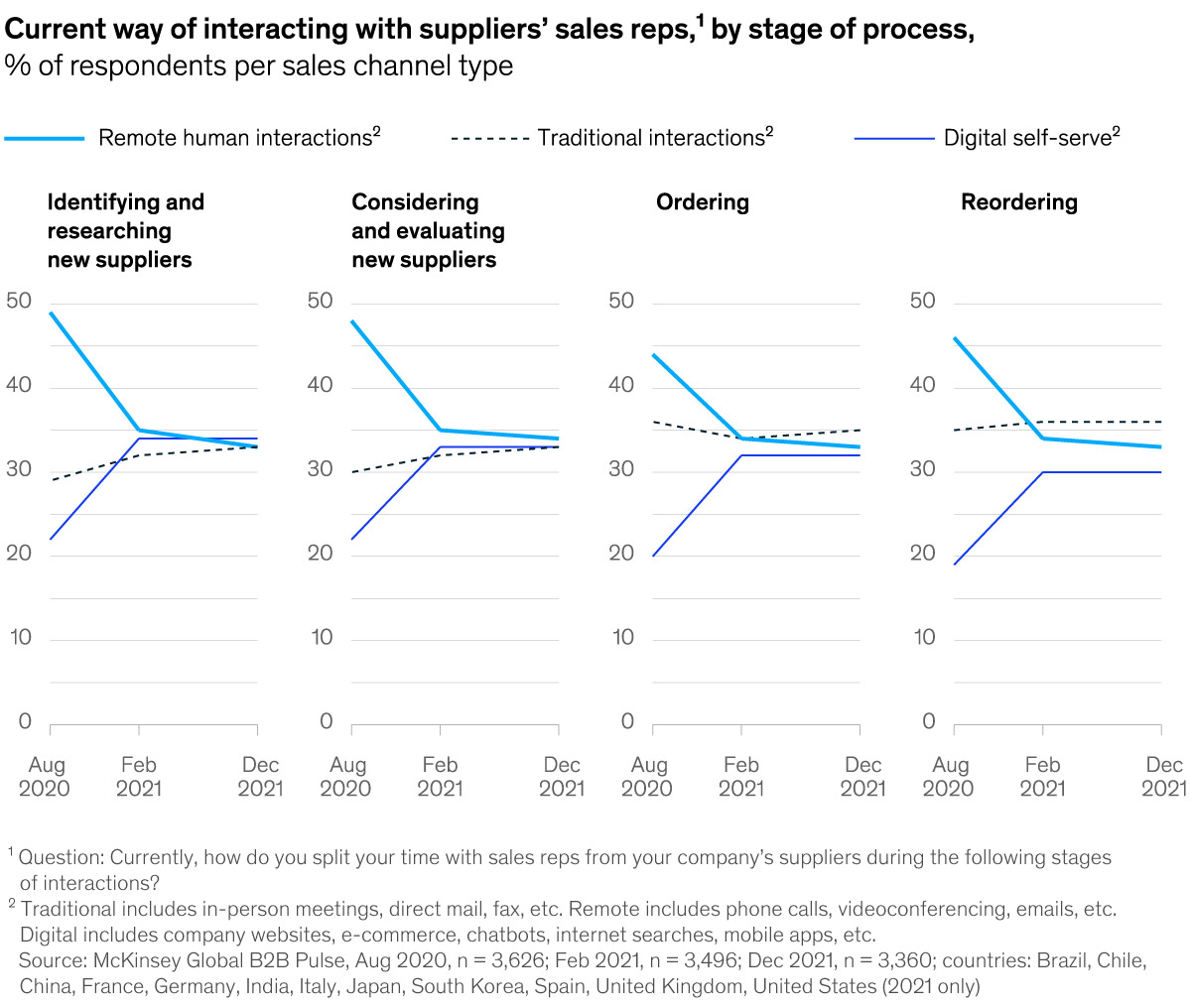
| Our best ideas, quick and curated | march 25, 2022 | | This week, we look at the progress being made in women’s healthcare and the challenges that remain. Plus, the pandemic is changing workplace design, and Tech for Execs explains how reordering the steps in data processing—from ETL to ELT—opens up a world of possibility for your data. | | | | | A gap in care. Women, one half of the world’s population, account for 80 percent of consumer purchasing decisions in the healthcare industry. Yet women’s health has been considered a niche market—a subset of healthcare. Approximately 1 percent of healthcare research and innovation is invested in female-specific conditions beyond oncology. Women have been underrepresented in medical trials, and the current global innovation pipeline reveals mismatches between health investments and health needs as they relate to women. | | Making strides. The good news is that recent advances in genomics, tissue engineering, and cell and gene therapy can be applied to underserved female-specific conditions, creating better health outcomes for women. Current gaps also present new opportunities for investors, companies, and other stakeholders across the healthcare ecosystem. | | Where does ‘FemTech’ fit in? The term, coined by the entrepreneur Ida Tin in 2016, encompasses software and tech solutions that improve healthcare for women, including maternal health, fertility, menopause, and general health conditions that affect them disproportionately or differently (such as osteoporosis or cardiovascular disease). | | Since then, FemTech has grown to include a broader range of tech-enabled, consumer-centric products. For example, at-home diagnostics, trackers, and wearables are helping women take greater charge of their health and health-related data. Clinical-diagnostics companies are addressing unmet medical needs in areas such as endometriosis and preterm birth. And more companies are focusing on culturally sensitive and tailored care for Black women, LGBTQ+ populations, and women in low- and middle-income countries. | | Beyond maternity. McKinsey recently analyzed 763 FemTech companies and found that that public awareness, company formation, and funding are surging as FemTech’s impact grows in more categories. For instance, Maven Clinic, which started as a virtual clinic in maternity care and expanded across the reproductive life cycle, is now valued at more than $1 billion. | | Solid momentum. Although FemTech companies currently receive just 3 percent of all digital-health funding, forecasts suggest opportunities for double-digit revenue growth. In our scan of hundreds of FemTech companies, we found that many are filling gaps not yet addressed by biopharma and device incumbents. In a short period, FemTech has already demonstrated impressive early wins, improving women’s lives in a way that redounds across society. An even greater disruption could be ahead. | | |  | | OFF THE CHARTS | | The B2B balancing act | | Although B2B companies have swung between e-commerce sales and field sales during the various stages of the COVID-19 pandemic, more buyers are now aiming for balance. A recent McKinsey Global Survey of thousands of B2B decision makers found that they have settled into using a mix of sales channels, although videoconferencing and emails have declined since the start of the pandemic. | | | | | | | | | | INTERVIEW | | The rebirth of workplace design | | Diane Hoskins, co-CEO of Gensler, a global design and architecture firm, has been thinking about effective workplaces for decades. In a recent interview, she discusses how COVID-19 has disrupted workplace norms, such as forcing companies to rethink open-plan offices that had been a source of distraction and stress for many workers even before the pandemic. “From a design standpoint, there’s now a conversation about what is the role of workplaces at the individual-worker level and not just at the company, industry, or world level,” Hoskins said. “That is a very powerful shift. It opens the door to new solutions that may be unexpected.” | | | | | | | | TECH FOR EXECS | | The ABCs of ELT—or is it ETL? | | Our experts serve up a periodic look at the technology concepts leaders need to understand to help their organizations grow and thrive in the digital age. | | What it is. ELT or ETL, regardless of the order of letters, stands for extract, transform, and load. Collectively, these terms refer to the process of moving data from a source (such as a point-of-sale system) to an intermediate location (such as a relational database) from where the data can be accessed by an application (such as an AI-driven recommendation engine that suggests the next gadget you should buy based on your past purchases). | | Why it matters. The order of the letters does matter to businesses. Technology innovations enabled a shift from on-premise ETL to cloud-based ELT, which has arguably paved the way for virtually any company to create value from data—for example, by powering AI that’s now contributing significantly to bottom lines. | | From the 1970s through the early 2000s, a data point extracted from a source was sent to an intermediary system that transformed it into whatever format its database destination required—for example, sorting it into specific structured fields—and then forwarded it on to be loaded to that database (E-T-L). | | Along came a new suite of database systems in the 2000s to manage big (and messy) data in data lakes and enable E-L-T. Businesses could now extract data from multiple sources in their original, raw format and load them straight into a data lake where they could then be transformed into any number of formats needed by various applications—no intermediary data-preprocessing system required. An added bonus: data scientists could access and explore the raw data in the data lake as they worked on new applications, rather than having to tap back into varied and sundry source systems. Soon after, the cloud made ELT even easier—businesses could create data lakes and set up APIs (explained in last month's Tech for Execs) to move the data from them to applications without having to worry about physical infrastructure. | | What the benefits are. ELT reduces cost and complexity and speeds up data processing. It also provides flexibility, since it allows easier movement of any data type—structured (tabular), unstructured (text, video), or anything in between—to multiple applications and enables data scientists and engineers to query and work with data in one place, fostering innovation. | | ETL isn’t dead. ELT hasn’t completely supplanted ETL, as there are cases where ETL is necessary. For example, it’s often needed when legacy infrastructure is in play or when it’s beneficial to use an intermediary system to anonymize personal data before sending it to a data lake (as opposed to configuring myriad guardrails for access to the data lake). | | Embrace cloudiness. Enabling faster and more flexible data management is one of the many benefits of moving to the cloud. If you don’t have a cloud strategy to drive business outcomes beyond IT cost savings, it’s time to craft one—a cloud transformation engine can help. | | What technology concepts would you like us to help explain next? Let us know. | | | — Edited by Barbara Tierney | | | Share this Tech For Execs |  |  |  | | | | | | BACKTALK | | Have feedback or other ideas? We’d love to hear from you. | | | | | Did you enjoy this newsletter? Forward it to colleagues and friends so they can subscribe too.
Was this issue forwarded to you? Sign up for it and sample our 40+ other free email subscriptions here. | | | This email contains information about McKinsey’s research, insights, services, or events. By opening our emails or clicking on links, you agree to our use of cookies and web tracking technology. For more information on how we use and protect your information, please review our privacy policy. | | You received this email because you subscribed to The Shortlist newsletter. | | | | Copyright © 2022 | McKinsey & Company, 3 World Trade Center, 175 Greenwich Street, New York, NY 10007 | | | |